


2 Billion. That is the number of scam and spam communications our Wisely Ai platform intercepted on Indosat Ooredoo Hutchison's network in six months. It is also the number of times someone in Indonesia did not get deceived and did not lose money. Did not become one of the 51% of victims who report significant stress or trauma.
Numbers at this scale can start feeling intangible. So it is worth slowing them down and asking what each actually required.
In May 2026, London Business School published two case studies documenting our deployment with Indosat. The researchers had access to operational data and customer research, as well as earnings filings and leadership at both companies. What follows is our reading of those numbers. We will talk about what they represent and what they tell us about where the industry goes next.
99% detection efficacy
99% sounds like near-perfection. On a network processing billions of communications, it is something more useful. Production-grade accuracy under adversarial conditions, maintained continuously against opponents who adapt faster than any static system can follow.
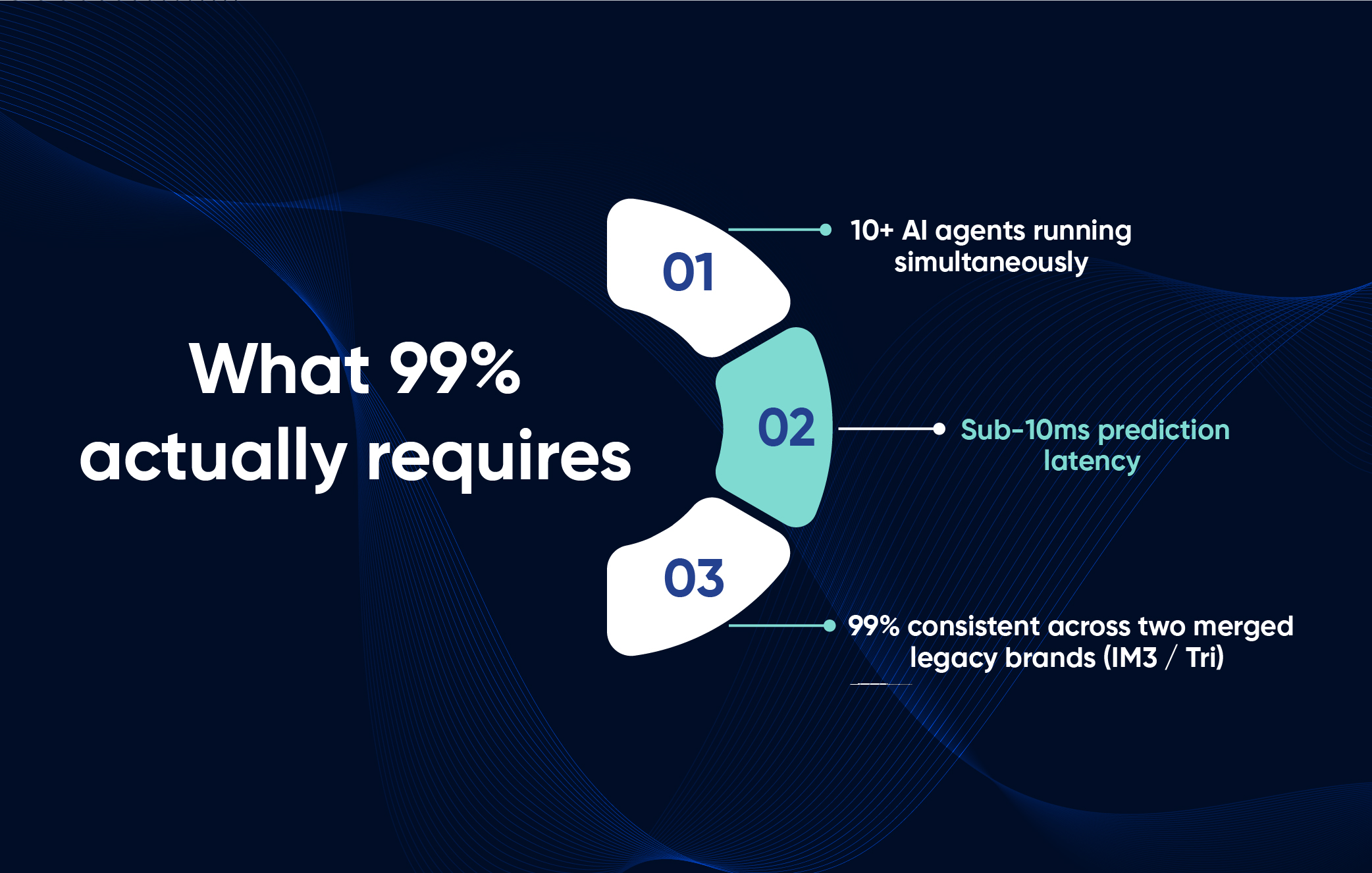
Our platform runs 10+ AI agents simultaneously. They analyze sender reputation and message semantics alongside call-to-action patterns and traffic velocity. They track link reuse, historical outcomes, and network-level correlations. Each agent makes autonomous classification decisions in real time at sub-10ms prediction latency on NVIDIA Blackwell architecture. The 99% holds across both of Indosat's post-merger brands( IM3 through SATSPAM and Tri through its parallel TRI AI feature). That consistency across two inherited systems from the 2022 merger was a non-trivial technical challenge.
Scam messages in Indonesia rely on colloquial phrasing and culturally specific cues poorly captured by models trained on other markets. Legitimate messages from small businesses, sent in irregular bursts, resemble scam campaigns. Fraud attempts wrapped in holiday greetings look like ordinary conversation.
The LBS case study captured the operational reality precisely: "AI, in this context, was not a self-running system but a continuously tended one." That ongoing human effort is a real, recurring cost. It is also the reason the 99% number holds.
95% feel protected, the remaining 30% tells us where to go next
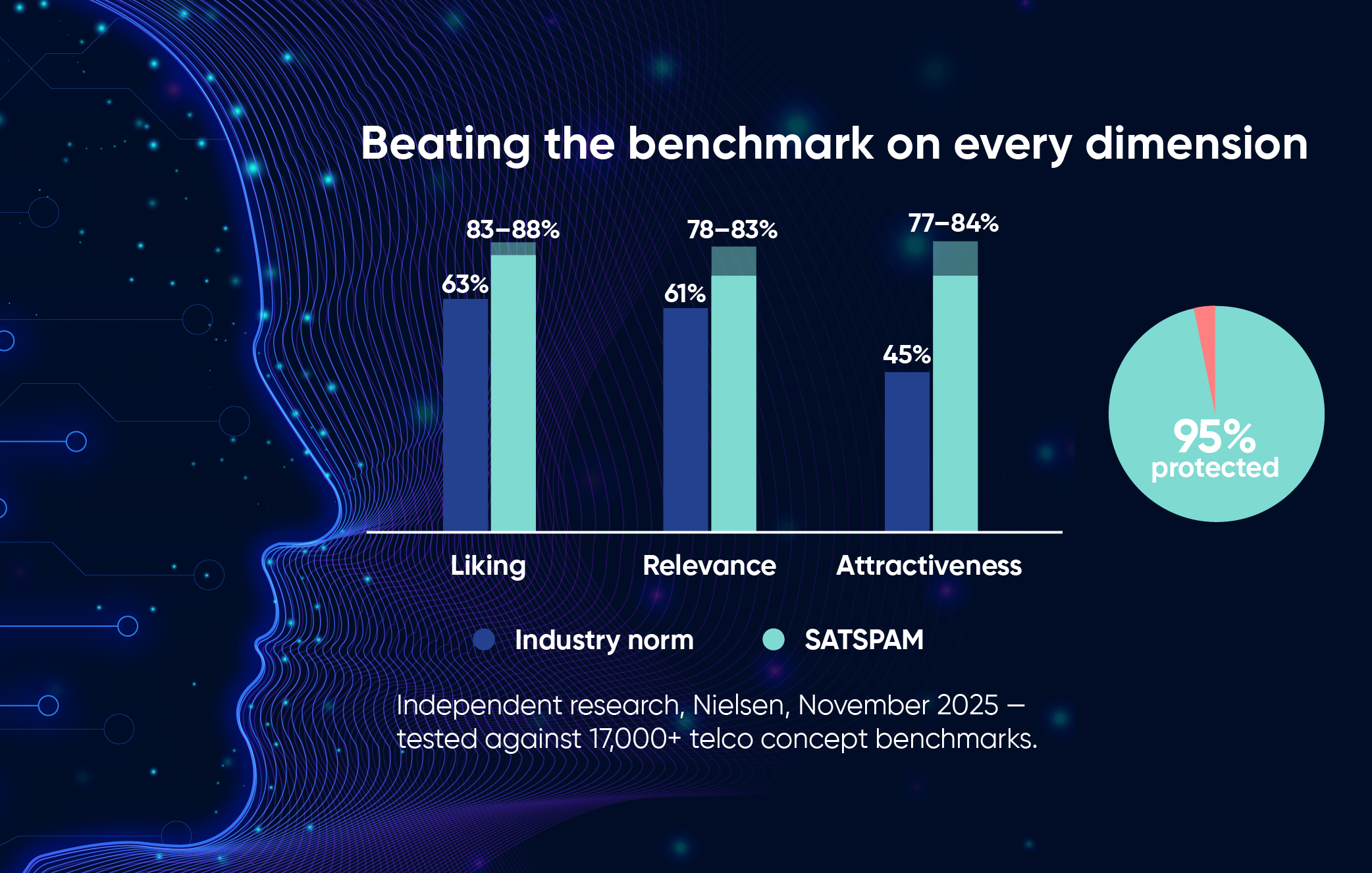
Nielsen conducted independent research in November 2025 against a database of over 17,000 telco concept tests. The SATSPAM concept scored well above industry benchmarks. Liking reached 83 to 88% versus a norm of 63. Relevance scored 78 to 83% against a norm of 61. Attractiveness hit 77 to 84% against a norm of 45. Among activated users, 95% reported feeling "protected" or "very protected." Net Promoter Scores ranged from +20 to +25. Satisfaction ran between 75 and 87 out of 100.
At the same time, roughly one-quarter of users reported no noticeable difference after activation. Around 30% did not clearly understand what the service did.
This is the invisible-product paradox. Understanding it may be our single most important strategic insight. When protection works, nothing happens. Nothing happening is precisely what users expected from their network in the first place. Scam-free communication feels like a baseline obligation. Indosat's leadership came to see invisibility as the core of the value proposition, the strongest signal of success being quiet.
This paradox has played out before. Credit card networks resolved it by embedding fraud protection into interchange fees. Users never see the cost. They never notice the intervention unless it fails. The 95% tells us protection landed. The 30% tells us where the product experience needs to go next.
10.5% ARPU growth
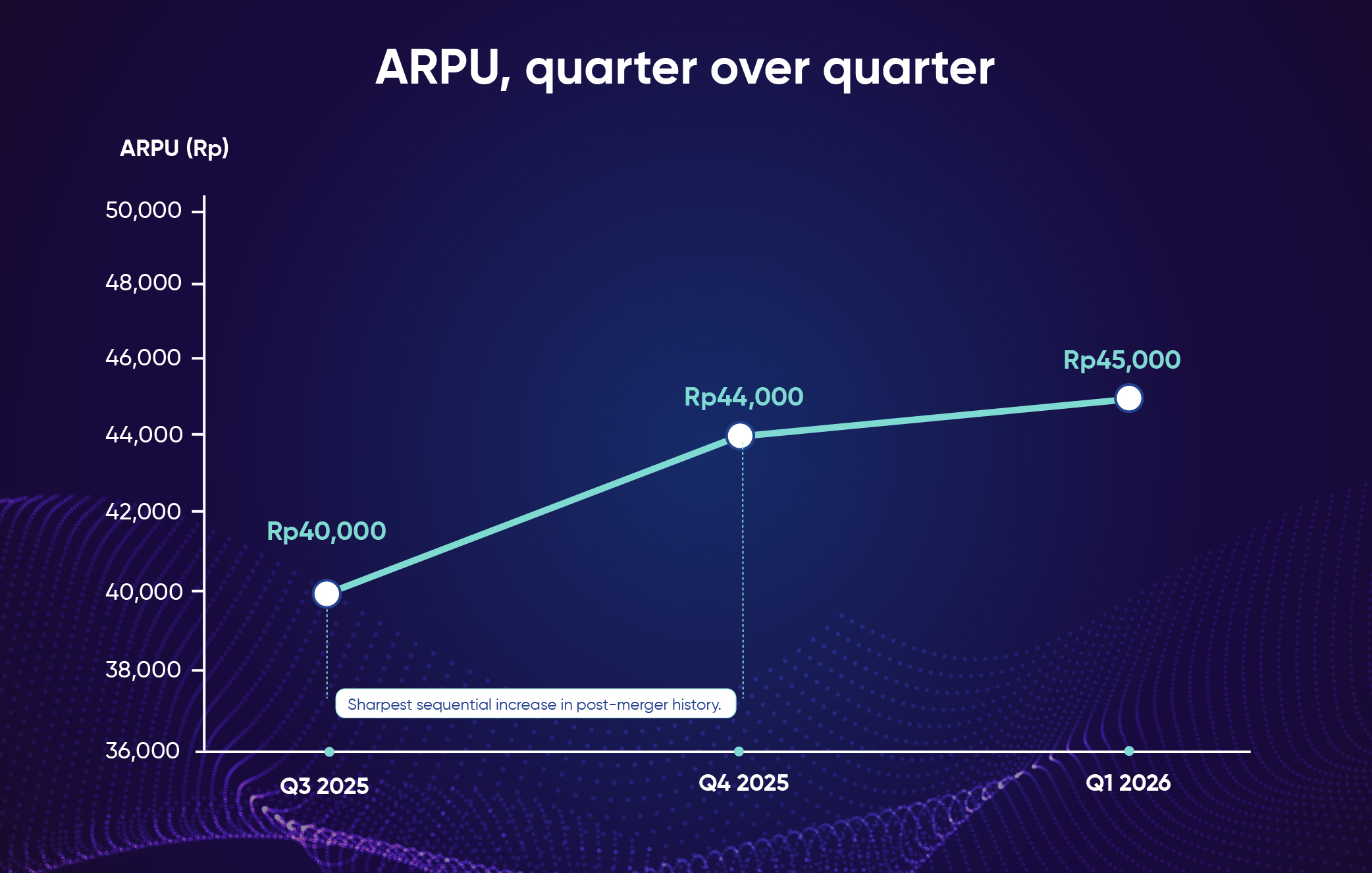
Indosat's average revenue per user climbed from Rp40,000 to Rp44,000 in Q4 2025. That was the sharpest sequential increase in post-merger history. ARPU reached Rp45,000 by Q1 2026. That 15.3% year-over-year gain drove double-digit revenue growth. Revenue rose 9% sequentially. EBITDA grew 12%. Normalized net profit increased 51%.
The LBS case study used a conservative model. It pointed to a directional ROI of approximately 15 to 20x, with an estimated 20 to 40% contribution to ARPU uplift and churn reduction. Wherever AI-powered trust infrastructure has been deployed at scale, the commercial signal points the same way.
$500 million in prevented losses
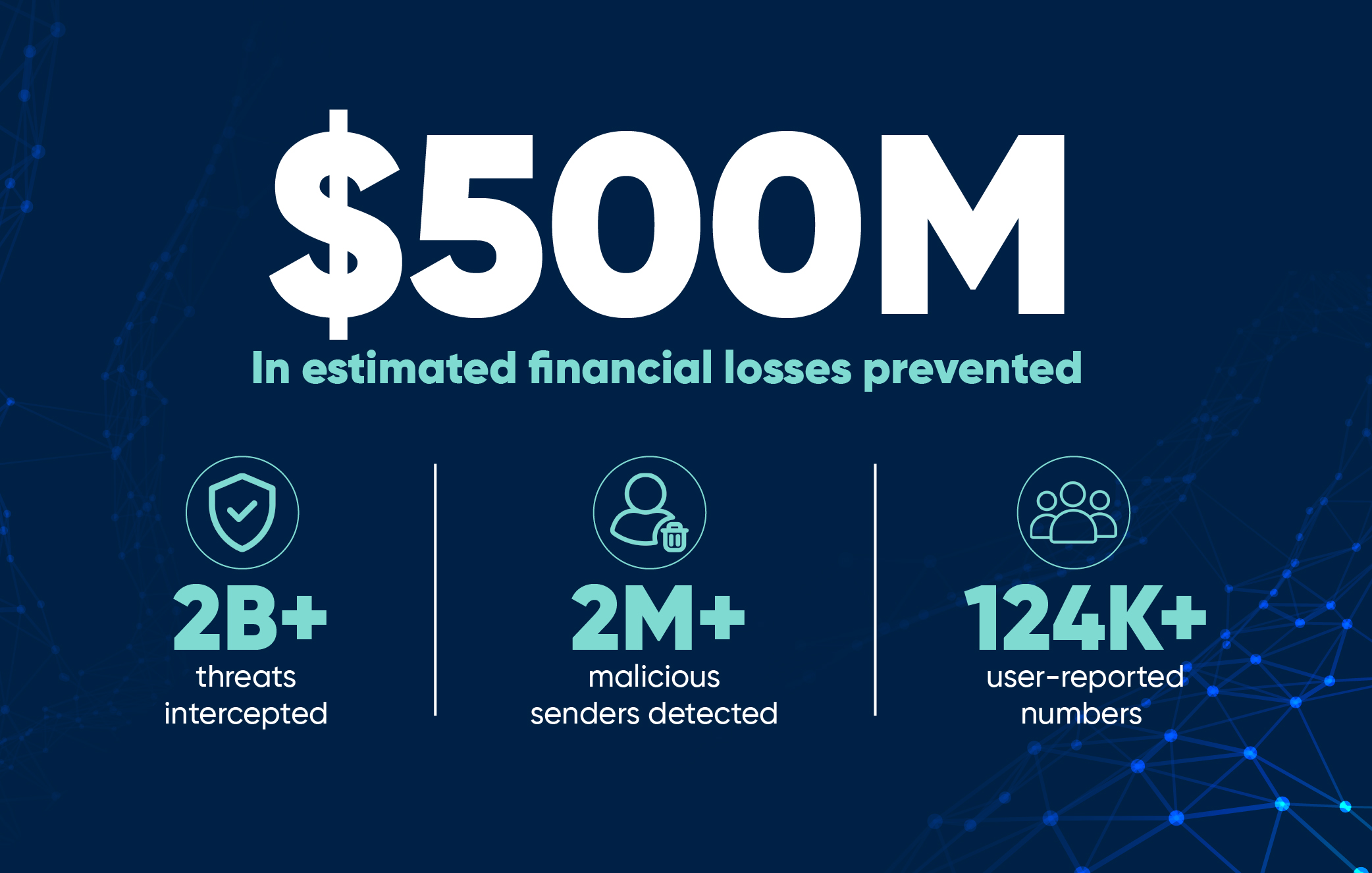
The $500 million is our estimate(developed jointly with Indosat) of the financial losses prevented by Wisely Ai intercepting two billion-plus threats. More than two million malicious senders and call-to-action elements detected. Over 124,000 user-submitted reports of fraudulent numbers. And 2.5 million active app users voluntarily flagging suspicious activity, creating a feedback loop that strengthens detection with every report filed.
That feedback loop may be the most significant metric in the entire case study. Static firewalls cannot replicate it. A system that learns from its own users' reports compounds in a way that bolted-on AI features structurally cannot. More participants means better detection for everyone.
16.8% decline in regulatory complaints with Indosat numbers
There is a number in the case study that received less attention than the large volumes but is equally as important. Regulatory complaints involving Indosat numbers decreased 16.8% month-on-month in August 2025. That was the first month of the deployment. Trouble tickets across both brands dropped to single digits.
These showed up in operational reporting. They were signals visible to Indonesia's Ministry of Communication and Digital Affairs, Komdigi, in real time. And they are what made the rest of the deployment possible.
When SATSPAM launched in August 2025, our platform was limited to identifying scams and alerting users. We could flag a fraudulent SMS. We could warn a subscriber before they picked up a suspicious call. We could not block anything. Subscribers remained exposed to messages designed to prompt immediate action.
Blocking required regulatory approval. Regulatory approval required proof that the system could be trusted not to suppress legitimate communications. The complaint decline and the near-zero trouble ticket volume provided that proof. Three months after launch, Komdigi approved expanded enforcement: blocking scam SMS through AI detection and suppressing malicious domains via DNS-level controls. By January 2026, full enforcement was in place, including the authority to deactivate scammer phone numbers from the network entirely.
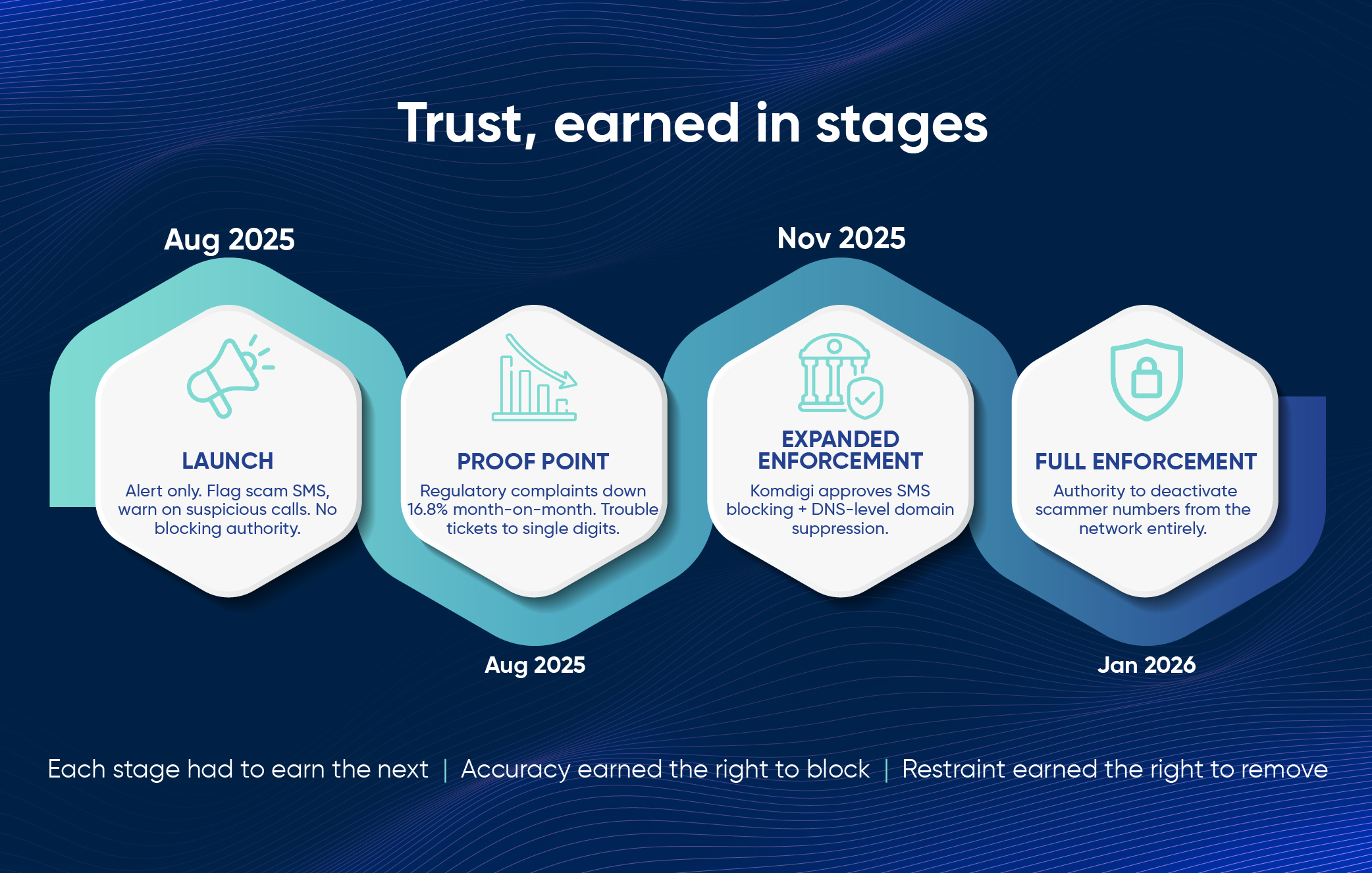
Each stage empowered the next. Alerting proved accuracy. Accuracy earned the right to block. Blocking proved restraint. The false-positive rate held and earned the right to remove offenders from the network altogether. The case study documented this as a deliberate regulatory strategy: "Progress through each stage required coordination with Indonesia's telecommunications regulator, with each phase building regulatory confidence before advancing to the next."
The scams that move
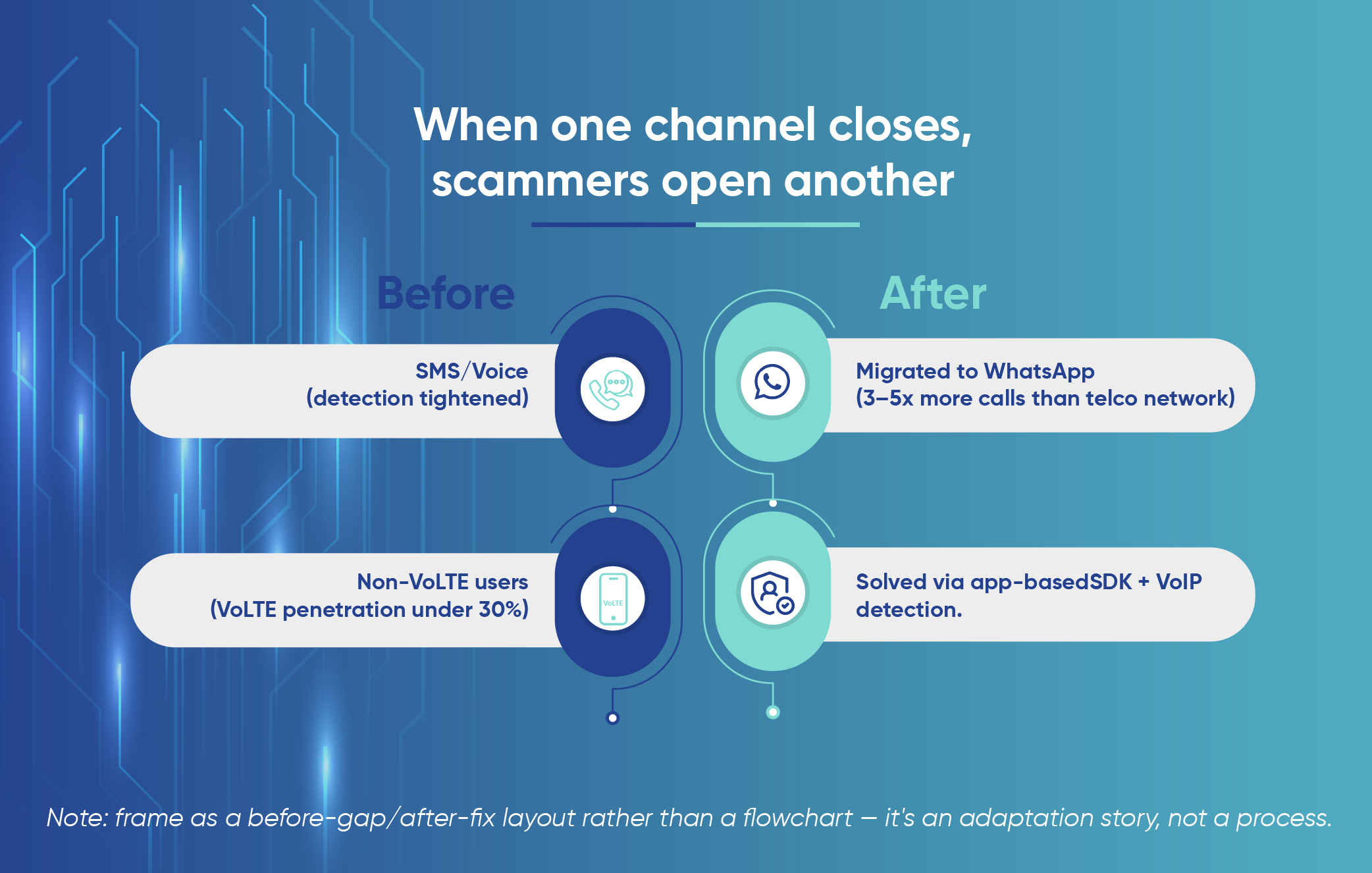
When our detection tightened on SMS and voice, scammers did not stop. Operational data revealed fraud migrating to WhatsApp, where Indonesian consumers made an estimated three to five times more calls than over the traditional telco network. Separately, we discovered VoLTE penetration on Indosat's network was below 30%. Network-based caller ID alerts could not reach most users.
Neither problem was in the original plan of action. Both required us to build capabilities that had not existed when we signed. We developed an app-based SDK embedded in Indosat's mobile application for non-VoLTE users. We added VoIP detection for WhatsApp calls. As the LBS researchers noted, "Both emerged from market learning and gaps realised to drive desired impact."
This adaptability is what separates an AI-native architecture from a bolted-on feature. Trend Micro projects that multi-channel scams will become the dominant fraud pattern in 2026. Victims lured from social media into encrypted chats and fraudulent payment pages. A system that cannot follow the threat across channels offers a boundary marker and nothing more.
The metric that matters most may be the speed at which the system adapts when the adversary changes the game.
What the numbers add up to, and where they point
The LBS case study frames Tanla’s competitive advantage as "cumulative learning acquired through operating at scale under adversarial conditions, embedded in workflows, and judgement that could not be easily transferred or compressed."
Algorithms and architecture can be replicated. Compounded learning under fire? Not so easily replicated.
McKinsey's 2025 State of AI data reaches the same conclusion from a different angle. The companies generating real value from AI are the ones 3× more likely to have fundamentally redesigned workflows. They rebuilt the process around AI rather than draping AI over the process they already had. The numbers in this case study are the output of that rebuild.
As of right now, the magnitude of threat remains larger than a single deployment can solve. Scams are a collective threat addressed, so far, by individual defenses. Wisely Ai protected 100 million users on one network.The next set of numbers worth measuring will come from the shared intelligence layer the industry has not yet built. We intend to be the ones at the forefront of this shift.


